Tuesday, 2 June 2020

SELF-PORTRAITS THROUGH OTHERS

It was my photographic intervention at the Carabanchel Penal Institution, December 1994, Madrid. 
Only a few artists invited to create our work in a prison, it was about turning the jail into a forum for cutting edge art. Concha Jerez, Nacho Criado, Pepe Iges, Isidoro Valcarcel Medina, and other young artists, we came up with projects that could be developed in confinement circumstances with convicts who wanted to participate.
We proposed to reflection on the role of art in segregated and excluded territories It was about fostering a meeting, and a mutual surprise that of the artist who comes from outside, and that of the inmate who is invited to work.
Before our meeting, I asked myself a question: when I draw or photograph a face do I represent my face, without intending to, about the one I am trying to portray? This could be connected with the concept of empathy: the child responds to his mother's smile and imitating his gesture, he interprets the face of the closest person. For empathy when we make a portrait, we project our appearance on other faces. 

A turning point in this project was in the first prison visit, I found unforeseen lighting circumstances, in a closed place, without natural light, we improvised a spotlight with the slide projector. 
Presenting my work as a collaboration proposal, I asked the inmates for help and, I showed them images of me that provided information on the future results. Besides, I touched on some technical and personal aspects that could connect with their concerns as image-creating photographers inside the enclosure. I was interested in showing that it was possible to construct images in a small space and somewhat precarious circumstances to elaborate own language. They accepted my proposal.

Firstly I thought to include my hand in the image; but finally, I decided, during the development of the on-site work, their hand should appear, with an object that I carried, they chose. We would make a half portrait or a double portrait: my face and his hand. Their hands, and my face, all the same, but different, became a challenge for those who see the images. You can see many things on the hand: the footprints, the age, the future, the past too.
As you might know, I carefully wrote down who had taken each photograph, and whose hand it was. With this material, I continued working in the studio. I took nine photographs, one for each portrait taken in prison (nine were the participants: six prisoners and three educators) in the first phase, until obtaining satisfactory results. 

I went back to jail and showed them the first evidence. I thought it is necessary to improve the quality of the results regarding sharpness and color and continued working in my studio. I took about 15 new pictures for each portrait. About 120 pictures. I made nine mural portraits of 100cm x 150cm, mounted, and screwed on methacrylate. 
Although initially, the formal approaches were clear, the results obtained surprised me: my face was always smiling (in the photos, I had taken in my previous work, the appearance was serene, very calm). 
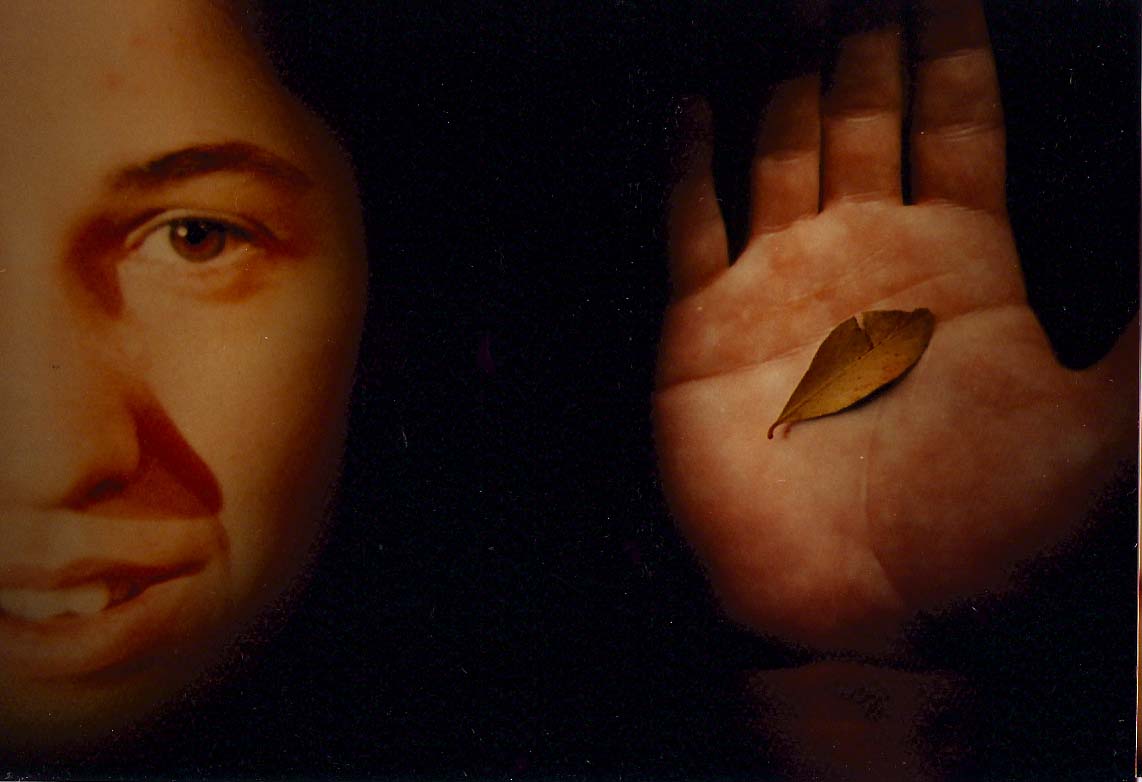
 However, this face in prison with a smile showed a complex emotional situation. The lighting was extremely dramatic; the shadow-light relationship turns the objects, face, and hand into appearances and contributes to giving a formal definition of the face and the different hand. Hands look like faces, faces look like hands. Is it the left or the right side? Is it a face or profile face?


Elements


More than emotion, I want to assert a claim to the suggestion, which is a kind of bridge between reason and unreason.

Her work titled "Ether" (1993) belongs to a series on the different elements, photographs in which the artist searches though motifs for asociaciones shown between a central nucleus and the rest of the surface of the photo, between proximity and distance, focus and lack of focus.
She is aware that in her works she is looking for spectators' engagement. This is why she uses fragments and gives clues though keeping areas of mystery:"It is thee way you place things in front of camera what transform them. This is why I take care of reorganizing what I photograph, why I choose the place and particular distance".

"Ether"

"Earth"

"Fire"

"Air"


"Water"


Spanish Vision

Maria José Gomez Redondo uses appropriations, double exposures and montages to create a dream-like work in which no monsters are allowed. In the series of her photographs in The Spanish Vision, she depicts the five senses, leaving the "sixth" sense to be deduced from these depictions-and the one which forms a part of her technique along with the other, more apparent ones.


"The sense of vision"


"the sense of touch"


"The sense of smell"

"The sense of hearing"

"The sense of taste"


In her first one-person show in December 1990 at the Circulo de Bellas Artes in Madrid. María José Gómez Redondo (Valladolid 1963) presented two kind of works: allegories of the senses and series of still-lifes with classical connections. Two series which can be taken as premonitory examples of the sort of work she has been developing since then, in which there is an inclination to tell stories mixed with subtle sensuality, translated into images, thanks to a precise control of the onlooker distance. She talks about it when she remembers her beginnings, when she used to paint: "After completing some photographic works in 1987 with Luis Mayo, I became so interested in that medium that I could not abandon it thought I concentrated my interest in photographing photos that I has seen in the press. I was convinced that art was closely related with exercise of learning to watch. I soon realized that not far from the image we see, there is another one, which is less stable, which seems to be moving, and decided to combined them, trying to raise the one which always left behind, hidden"

References:


Tuesday, 30 July 2019

The reality (Summer 2003)

I look at my thoughts like clouds: there is an idea that I stop, and another that escapes me.
We usually define reality as an independent fact of our will and thought as something intimate that happens to us, not real or illusory.
However, our thoughts stain our reality, and these become our way of looking and acting.
I will wait for a sweeter achievement.

One only among many words.

 I will wake up cheated.

Where the mind is stuck.

Behind the shield of grief.

I almost feel it's true.

It seems to be only pain.

It is held in the soul.

Monday, 29 July 2019

The unseen (December 2000)


It would be a paradox that using the photographic medium is intended to talk about the unseen. A medium tied to the vision is depicting, but what is the unseen?
The unseen is not the dark, nor mysterious. It is transparent, said Marcel Duchamp. That is the contention of the artwork exhibited in La Casa del Siglo XV Gallery.
They are images without distance, whose approach makes us perceive again that invisibility, that thinning of reality, as objects become dim until they become the veil, the atmospheric veil that teaches us to perceive distance.

These pieces convey an identification: supports used with images represented. These are photographs printed on canvas, in which fabrics are depicted in this way, that vehicle of representation is diluted in that identity of materials, making it insensible.
The works presented in the exhibition are:
Four large fabrics show veiled faces, submerged in the folds of the sheets, the space in which we remain a large part of our lives: at the beginning and the end of these, in love and sleep.
Several objects on canvas printed on the same support acquire a symbolic value.

A vertical arm, which holds a plant with a clenched fist, can only see the stem and golden roots opened on the forearm, creating metaphorical parallelism with references to life.
The Seas are four images mounted in boxes of methacrylate in which soaps are on the water. Surrounded by a white aura of foam, the object stops being to become the media.


Saturday, 18 August 2018

Tribute to Emily Dickinson's Poems


Diary 54 

I made my 54th Diary to make tribute to Emily Dikinson's Poems beautifully translated to Spanish by Amalia Rodriguez Monroy


Wednesday, 9 August 2017

Art and Process: River poems

By María José Gómez Redondo


I would like to create a small gallery of artistic visual processes

It is a space to expose sketches, notebooks, or diaries.


There is also room for theoretical reflection on the artistic process.


As a beginning, a quotation of Theodor Adorno.


"Art is not exhausted in what can do, but this process makes the work of art have its language, search for the language of the thing."

Ornament. Theodor W. Aesthetic theory.


River poems


I packed thoughts that circulated in my mind and rolled them up in small glass tubes.


Capture clouds

Detained body
Disguised as words
Impulse  disguised
Live fast